Posts

READY FOR TOMORROW: The Future of Work

The future of work is not too far from today. A comprehensive strategy focused on employability and employment generation is a must to ensure a smooth transition for our workforce . By Chetan Kapoor The true beauty of India lies in its diversity. I have been working in the social sector for over two decades and have had the privilege of closely viewing many Indias within one India.   There is an India that closely follows, if not leads, global trends of innovation and upskilling. It is an India with a workforce that is highly aspirational, well-educated, efficient and professional — a workforce that can give its competitors a run for their money on any given day. In this India, workers are compensated quite well, live in clean and safe environments and have access to quality infrastructure and healthcare. The other India has a far bigger workforce. These people toil every day, sometimes even without a break or food for long hours, and mostly get very little for what they do. W...


Transitioning into the Development Sector? Here’s What To Keep in Mind

Image
Image Source: " crossroads " by  Laenulfean  is licensed under  CC BY-SA 2.0 . With experience spanning 25 years at a leading Indian conglomerate behind her, Vasudha Narasimhan was all set to scale greater heights in her professional career. Having graduated from a premier B-school in 1995, her CV included international assignments and several accolades that had come her way over the years. She was also managing her personal obligations well, with her daughter currently enrolled in medical school. And then, a few months after her 50 th  birthday, Vasudha decided to give up her well-paying job for one where she would be paid a pittance in comparison, at an NGO working for children’s education. ~~~ Vasudha’s is not an isolated example. T here are many like her, who at a similar stage in their careers have chosen to transition to the social development sector, with the sole objective of seeking a higher purpose in life. This trend has taken a significant turn with...

Compassion: The Essence of Social Responsibility

Image
Back in 2001, just around the time I turned 30, I was still struggling with the decision of what I wished to do with my life. I had an MBA degree from one of the most prestigious institutes in India in my bag, and a few years of corporate experience as well. Yet, the fulfilment I sought from what it takes to earn a living was singularly missing. Through a series of curious coincidences, I found myself drawn towards the arena of social development and education. By 2004, the needle had shifted considerably – I was heading the direct implementation unit of Pratham (one of the largest charities working in primary education in India) for North India, responsible for the delivery of basic learning to over 200,000 children across several north Indian states. The past twenty years has been an incredible journey, during which I have held leadership positions in organizations such as American India Foundation, Bharti Foundation, and now, Tech Mahindra Foundation. I have also taken a ...

Creating Social Value: The Joys and Perils of being a Social Entrepreneur

Image
While surfing the net, I recently came across a list of the top ten social entrepreneurship heroes in India. The list had Mahatma Gandhi as the first entry, and the others that made the grade were Dr. Verghese Kurien, Vikram Akula, Sam Pitroda, and Sunil Bharti Mittal. If this list appears somewhat eclectic, it is only because the term Social Entrepreneurship does not have a standard definition. It is usually referred to the type of entrepreneurship that is concerned with finding a solution for a social problem, and then applying the solution at scale. Unlike conventional (or commercial) entrepreneurship, where the focus is on maximizing returns for the shareholders irrespective of whether the enterprise has a social benefit, the focus of a social entrepreneur is on maximizing returns for the society. A social enterprise can be structured as a non-profit or a for-profit, is generally philanthropic in nature, but is not dependent on charity for its sustenance. In the Indian co...

Chronicles of a Failed State - Part 2

Image
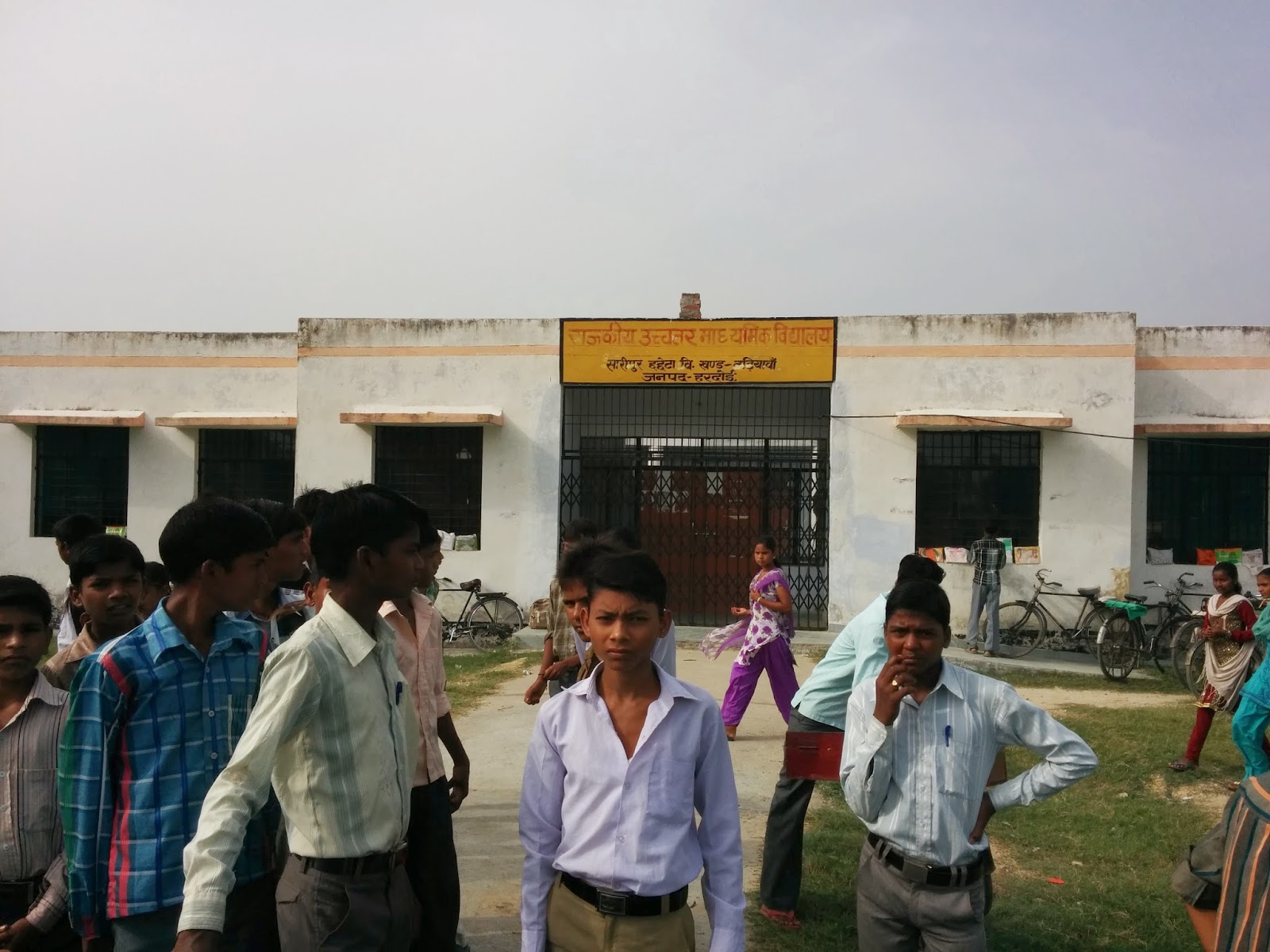
"The redemption of this education system cannot happen," says the gentleman to my left somewhat pontifically, "till the time the children have the katora (bowl) in their hands!" I am in Hardoi, a district to the west of Lucknow in the heart of Uttar Pradesh, for a new Edulever project. Rains have eluded this part of the state this year, and a disconcerting sultriness hangs in the air. Hardoi town, with a population of 170,000, seems like any one of the numerous small towns that dot the north Indian landscape. Its most recent claim to fame is that the 2012 Bollywood movie Ishaqzaade was shot in the district. Over two-and-a-half days, we visit a few senior secondary schools - also known as Inter Colleges - in parts of Hardoi. These schools typically run from Classes 9 to 12, and the ones in the villages are usually plain-looking single-storied structures. Enrollments vary - from as low as 50 students in Classes 9 and 10 in some cases, to as high as 750 in others...

Chronicles of a Failed State

Image
The recently completed Shaheed Path in Lucknow - an elevated 6-lane expressway that allows quick access from the airport to eastern UP - is a driver's delight. If you're travelling to Faizabad, for example, the road can get you speeding towards your destination, bypassing Lucknow city almost completely, in a matter of minutes. If your visit is during the waning winter season, you will be enthralled by the miles of mustard fields on the way - the enchanting yellow atop green stretching for as far as the eyes can see. You can do your business in Faizabad and be back at the Lucknow airport to catch an evening flight, carrying with you an idyllic portrait of rural India, and feeling smug about improved infrastructure in the state of UP. Venture a little within the state, and you will quickly realize how deceiving this idyllic portrait can be. Barely 40 kms from Lucknow, within the Lucknow district itself, is the Mal block. On 19 Feb 2014, I made a visit to Mal to understand th...

The Mid-Day Meal Muddle

Image
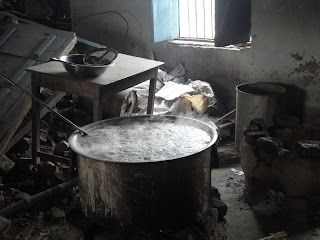
As the horrifying news of the mid-day meal tragedy in a government primary school in a village in Saran district near Patna burns the airwaves, I'm reminded of the day I spent at such a school in Samastipur (a district bordering Saran) some two years back. The meal being served to the children that rainy day had seemed anything but edible, even then. A look at the way it was being cooked (picture on the right) convinced me that such a tragedy was just waiting to happen. My mind also traveled to a conversation I once had with the Director of Primary Education of the Municipal Corporation of Delhi (MCD - which has since been trifurcated into three separate Corporations) a few years back. Commenting on the humongous task of ensuring cooked meal that had to be served to nearly a million children in about 1800 primary schools of the MCD every day, with a budget of just over Rs. 3 per meal, she lamented the politics behind the much touted mid-day meal scheme (MDMS) of the governmen...