Posts

Vocational Training: Whose job is it, anyway?
Image
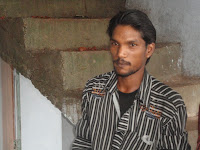
Raj Kishore Satnami is from the Kendrapada district in coastal Orissa, from where a large number of youngsters migrate to Delhi and Gurgaon to work as plumbers. He too is one of them. He has never been formally trained as a plumber, just picked up the skill on the job, working as an apprentice with a senior plumber. Raj has rarely felt the need for any formal training in his vocation. In early 2008, when the world was waking up to economic recession in the US, the Government of India had a wake-up call. Somewhere, someone in the corroded corridors of power realized that the Indian economy was ailing from - among other things - a serious Skills crisis. As terms such as "Unemployable" and "Skills Gap" found their way into the national HR lexicon, the expected reaction of the government was the formation of the Prime Minister's National Council of Skills Development, comprising senior cabinet ministers and industry stalwarts. The mandate of the council was ...

Ode to a Guru

Image
By early 1997, I had spent just under two years in the corporate sector, but these were enough to kindle in me several questions about whether this was really the ladder I wished to climb. A personal situation back home (in Patna) also catalyzed the existential questions, which were by now churning furiously in my 26-year old being. It was in these times that a friend recommended Stephen Covey's  7 Habits of Highly Effective People  to me. Though I'd always been fond of reading, and had a decent collection of books by them, the self-help kinds did not find a place in my library. So I took up  7 Habits  reluctantly to begin with, but within a few pages, was marveling at the resonance I found with what I was going through. The book helped me enormously during that fragile phase of life. I read and re-read the book, reflected upon it for hours, discussed the ideas contained in it with a few friends. This was a phase of intense introspection for me. Covey's ...

Satyamev Jayate....Jai ho!

Image
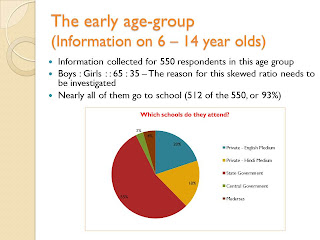
Last year summer, Edulever conducted a feasibility study for a vocational training program in the mofussil town of Saharanpur in western U.P. As a part of this, we conducted a survey covering 1000 households situated in lower-middle income areas of the town. The target was to interact with youth in the 15 - 25 age group, but we decided to extend our mandate and look at the education status among 6 - 14 year olds as well. It was in this second category of children that we found something seriously amiss. The slide from the final presentation on the survey in which we highlighted the gender skew Of the 550 children for whom information was collected, the ratio of boys to girls was 65-to-35. Even in the older age group, there were only 78 females for every 100 males (for a pool of 1687 respondents). These were randomly selected households, though a majority happened to be orthodox Hindu families. We could not probe further into the reason for the gender skew - it is likely that in...

The diagnosis is there...can we have the prescription please?

Image
That little boy in Grade 4 of the MCD school gave me a desolate, forlorn look...a look of desperation and helplessness. In front of him, on his desk, was a notebook. On it was his vain attempt to write a simple sentence in Hindi. Just a few minutes back, as I had walked into this classroom at the school in Nand Nagri in North Shahdara, Delhi, the children had greeted me with their singsong Good Morninnnnng, Sir! I had walked to the back of the class, and had asked this little boy whether he knew how to write. Yes, he had said confidently. Okay, I said, smiling at him. Can you write down this simple sentence? I opened a fresh page on his notebook in front of him, and dictated, "राम आम खाता  था", ensuring the words were all of the same easy vowel sound in Hindi (the long aa). He took his pencil, and started to write. Managed to write the first letter र. Added the aa sound to make it रा. Then stopped. Fumbled...thought...gave up. Looked at me with those helpless little eyes....

The Misfortune at the Bottom of the Pyramid

Image
Nearly 20% of India's population forms the base of the socio-economic pyramid, earning less than Rs. 100 per day By the time Mr. C.K. Prahalad published his most famous and cited work in August 2004, I had spent two years in Pratham, the largest primary education NGO in India. Till then, I had seen the innards of our metros - particularly Delhi and Mumbai - and had seen enough to know that the reverend management Guru had a point, but was not convinced in entirety. The book spoke of the BoP as the 4 billion poor of the world, living on an annual income of less than $1500 (which translated to just over Rs. 5000 per month then). In the Indian context, this Bottom of the Pyramid had a population of 400 million, around 40% of the country's people. But it was clearly visible, even then, that this BoP has several layers, and the bottom-most of these layers (often called the poorest of the poor) did not qualify for any of Prahalad's theorizations.  Thousands of young me...

Postcards from the hinterland...

Image
I love my job! Especially on days when it takes me to some far-away, less-traveled destination. Over the past year-and-a-half, thanks to a project on evaluating the work of NGOs working on migrant workers, I've had the chance to visit several such locations across the country. Each visit has given me the chance to look at our land closely, to see nature at its most pristine. Here's a glimpse of some of these visits... This stretch of desert land comes to your left on the road from Jodhpur to Barmer in western Rajasthan. It's not the whole desert - just a small slice of it - as if nature decided to give you a sneak preview of the real thing that starts beyond Barmer. Needless to say, this came as a huge surprise as the rest of the land around is barren, but not really a desert. Sunrise near a hamlet called Devli in Mirzapur district, U.P. The Arthik Anusandhan Kendra runs a training centre at Devli, which springs at you in the middle of nowhere. I'd spent a n...

Saraswati still resides in Chaita...

Image
A brick road runs through the center of the village. It had rained heavily the previous evening; we are greeted with the warm smell of fresh earth and cowdung. Chaitasangma is one of numerous villages that dot the landscape of north Bihar, situated around 100 kms to the north of the capital city of Patna. I am there as part of a recce for a forthcoming project for Edulever. The people aren't sure what we are doing here. They look at us with a mixture of suspicion and anticipation. The people are largely the women and the children - the men of Chaita are in far-off Delhi and Punjab, some working as construction labor, others as rickshaw-pullers. The women lament that their children have no option but to grow up without their fathers - who are here only for the festival season. Since Chhath , the largest festival of Bihar, is round the corner, the menfolk's arrival is eagerly awaited in Chaita. It's not 10 am as yet, so the children are not in school. Not yet. So...