Posts

Satyamev Jayate....Jai ho!
Image
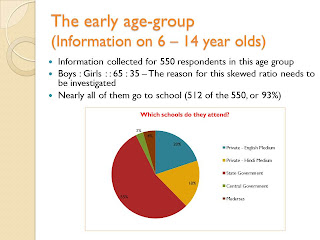
Last year summer, Edulever conducted a feasibility study for a vocational training program in the mofussil town of Saharanpur in western U.P. As a part of this, we conducted a survey covering 1000 households situated in lower-middle income areas of the town. The target was to interact with youth in the 15 - 25 age group, but we decided to extend our mandate and look at the education status among 6 - 14 year olds as well. It was in this second category of children that we found something seriously amiss. The slide from the final presentation on the survey in which we highlighted the gender skew Of the 550 children for whom information was collected, the ratio of boys to girls was 65-to-35. Even in the older age group, there were only 78 females for every 100 males (for a pool of 1687 respondents). These were randomly selected households, though a majority happened to be orthodox Hindu families. We could not probe further into the reason for the gender skew - it is likely that in...

The diagnosis is there...can we have the prescription please?

Image
That little boy in Grade 4 of the MCD school gave me a desolate, forlorn look...a look of desperation and helplessness. In front of him, on his desk, was a notebook. On it was his vain attempt to write a simple sentence in Hindi. Just a few minutes back, as I had walked into this classroom at the school in Nand Nagri in North Shahdara, Delhi, the children had greeted me with their singsong Good Morninnnnng, Sir! I had walked to the back of the class, and had asked this little boy whether he knew how to write. Yes, he had said confidently. Okay, I said, smiling at him. Can you write down this simple sentence? I opened a fresh page on his notebook in front of him, and dictated, "राम आम खाता  था", ensuring the words were all of the same easy vowel sound in Hindi (the long aa). He took his pencil, and started to write. Managed to write the first letter र. Added the aa sound to make it रा. Then stopped. Fumbled...thought...gave up. Looked at me with those helpless little eyes....

The Misfortune at the Bottom of the Pyramid

Image
Nearly 20% of India's population forms the base of the socio-economic pyramid, earning less than Rs. 100 per day By the time Mr. C.K. Prahalad published his most famous and cited work in August 2004, I had spent two years in Pratham, the largest primary education NGO in India. Till then, I had seen the innards of our metros - particularly Delhi and Mumbai - and had seen enough to know that the reverend management Guru had a point, but was not convinced in entirety. The book spoke of the BoP as the 4 billion poor of the world, living on an annual income of less than $1500 (which translated to just over Rs. 5000 per month then). In the Indian context, this Bottom of the Pyramid had a population of 400 million, around 40% of the country's people. But it was clearly visible, even then, that this BoP has several layers, and the bottom-most of these layers (often called the poorest of the poor) did not qualify for any of Prahalad's theorizations.  Thousands of young me...

Postcards from the hinterland...

Image
I love my job! Especially on days when it takes me to some far-away, less-traveled destination. Over the past year-and-a-half, thanks to a project on evaluating the work of NGOs working on migrant workers, I've had the chance to visit several such locations across the country. Each visit has given me the chance to look at our land closely, to see nature at its most pristine. Here's a glimpse of some of these visits... This stretch of desert land comes to your left on the road from Jodhpur to Barmer in western Rajasthan. It's not the whole desert - just a small slice of it - as if nature decided to give you a sneak preview of the real thing that starts beyond Barmer. Needless to say, this came as a huge surprise as the rest of the land around is barren, but not really a desert. Sunrise near a hamlet called Devli in Mirzapur district, U.P. The Arthik Anusandhan Kendra runs a training centre at Devli, which springs at you in the middle of nowhere. I'd spent a n...

Saraswati still resides in Chaita...

Image
A brick road runs through the center of the village. It had rained heavily the previous evening; we are greeted with the warm smell of fresh earth and cowdung. Chaitasangma is one of numerous villages that dot the landscape of north Bihar, situated around 100 kms to the north of the capital city of Patna. I am there as part of a recce for a forthcoming project for Edulever. The people aren't sure what we are doing here. They look at us with a mixture of suspicion and anticipation. The people are largely the women and the children - the men of Chaita are in far-off Delhi and Punjab, some working as construction labor, others as rickshaw-pullers. The women lament that their children have no option but to grow up without their fathers - who are here only for the festival season. Since Chhath , the largest festival of Bihar, is round the corner, the menfolk's arrival is eagerly awaited in Chaita. It's not 10 am as yet, so the children are not in school. Not yet. So...

Migrant Workers and the Civil Society

Image
"The Poor are the spiritual reserve of the world." I've just spent two illuminating days at an international conference on Migration at Ahmedabad. Titled "Migration Practice - Pushing Borders", the conference had civil society representatives working in the field of migration from China, USA, Germany, and India. It was organized jointly by Transatlantic Forum on Migration & Integration and Aajeevika Bureau . That Migration for the sake of furthering livelihood is a global phenomena is well known; yet getting to know about the issue from an international perspective -- and how different nations are dealing with it -- was enriching, to say the least. Over the two days, I learnt about the challenges the European Union faces in its free-border policy, of how there's talk of Schengen Visa rules being rolled back. I got a glimpse of the massive rural to urban migration happening in China over the last decade and a half, and of the desperation of Centra...

A lesson from Mr. Ambani

GRANULARITY. It was the first time I had heard this word. And that too from no less than Mr. Mukesh Ambani. In person. This was 2002, Reliance was still one, and the Sensex was touching new highs to reach the 3000 mark! Mr. Ambani was on the board of Pratham India Education Initiative (PIEI), an industry body that - among other things - sponsored professionals to work for Pratham. I happened to be one such professional, and soon after joining, found myself in the board room of Reliance in Mumbai where the AGM of PIEI was being held. Other than Mr. Ambani, Mr. N. Vaghul (the then chairperson of ICICI) and Mr. Ajay Piramal were in attendance. I was, obviously, in awe. My seniors at Pratham made their presentations to the board about the work the NGO had done over the past year. Future plans were presented. Large numbers were bandied. The need to spread Pratham's work in every corner of the country was expressed. While all this was going on, Mr. Ambani appeared preoccupied in run...